
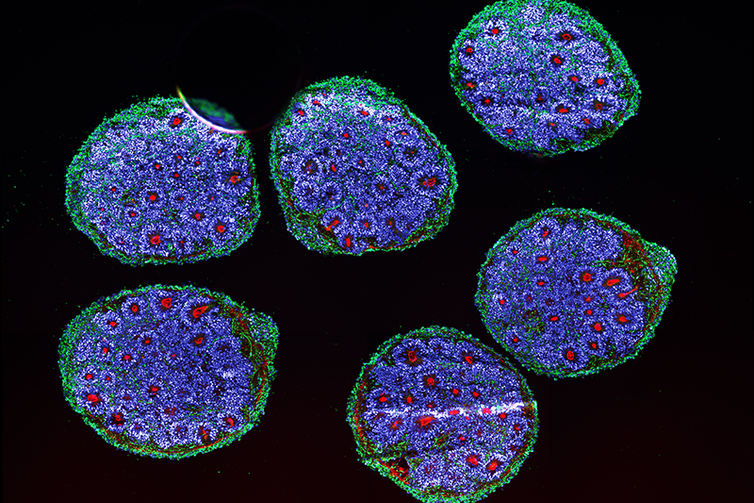
(cover: human brain organoids showing neurons and their dendrites (green), telencephalic (forebrain) cells (blue), and a kind of cell-cell contact called tight junctions (red). Credit: Noelia Anton Bolanos and Irene Faravelli)
Ever wondered what it would be like to have a mini version of your liver or brain sitting in a lab dish? Well, scientists aren’t just wondering, they’re doing it! Meet organoids: these three-dimensional, self-organizing cell clusters are like the miniature versions of our organs that you never knew you needed. They’ve been making waves in biomedical research, offering new ways to study everything from organ development to disease treatment. So what’s all the hype about these “mini-organs”, and how are they formed?
The Birth of Organoids: From Science Fiction to Lab Reality
The story of organoids begins in the early 2000s when stem cell biology and tissue engineering were starting to get to know each other. In 2009, Yoshiki Sasai and his team at the RIKEN Center in Japan showed that stem cells could self-organize into structures that looked a lot like human organs, especially brain tissues (the organ mystery of humans). Think of it as the moment when stem cells stopped being mere blobs in a dish and started behaving like tiny architects with experience: building organ-like structures all on their own.

The Teenage Years: Expansion and Refinement in the 2010s
By the 2010s, organoids were going through their growth spurt. Scientists began creating organoids for all sorts of organs: liver, intestine, pancreas, you name it. Breakthroughs in 3D culture techniques and stem cell research allowed researchers to refine these models, making them more complex and more accurate. It was like moving from stick figures to realistic sketches in the world of cellular biology. Suddenly, we had tiny, functioning replicas of various organs that could be used for research, drug testing, and even personalized medicine.
The Present Day: Organoids in Their Prime
Fast forward to the 2020s, and organoids have hit their stride. They’re no longer just cool science experiments; they’re essential tools in modern research. Today, they’re being used to understand how organs develop, how diseases progress, and how different patients might respond to various treatments. Researchers are even integrating them with other technologies like advanced imaging and organs-on-chips* to create comprehensive models of human physiology. It’s like creating a mini-version of yourself that you can experiment on (minus the ethical issues, of course).
* Will be explained in an upcoming post soon
Why Are Organoids a Big Deal?
Organoids are more than just exciting projects for scientists in labs. They’re changing the game -biology and medicine- in several key areas:
- Disease Modeling Done Right: Imagine being able to grow a patient’s tumor in a dish and test different therapies on it to see what works best. As incredible it may seem, that’s what organoids can do right now. From cancer to cystic fibrosis, these mini-organs allow researchers to study diseases in ways that were previously impossible. They offer a front-row seat to disease progression and treatment responses, all without leaving the lab. This is especially important for diseases we could not look in the eye before, like Parkinson’s or Alzheimer’s.
- Drug Screening with a Twist: Drug development has always been a bit of a shot in the dark. Not with organoids though, which provide a much more accurate representation of how drugs will affect human tissues. Want to see how a new drug affects the liver? Use a liver organoid! Curious about intestinal absorption? There’s an organoid for that too. These models can help researchers spot potential problems before a drug reaches a clinical trial.
- The Holy Grail: Regenerative Medicine: While we’re not quite at the point where we can grow fully functional organs in a dish, organoids are getting us closer. For instance, liver organoids might one day be used to generate functional liver tissue for transplantation in patients with liver failure. It’s like having a spare tire for your body, only way cooler and a lot more useful (minus the steel and rubber).
Advantages Over the Old-School Methods
If you’re wondering why everyone’s so excited about organoids, here’s a quick breakdown:
- Closer to the Real Thing: Unlike flat 2D cell cultures that don’t capture the complexity of human organs, organoids offer a more realistic model. They’ve got the 3D structure, the cell diversity, and the functionality to match. That’s as close as we can get for now.
- Personalized Medicine on the Horizon: Because organoids can be made from a patient’s own cells, they offer a platform for personalized drug testing. Imagine a world where your treatment plan is based on how your mini-liver reacts to different therapies. The future’s looking pretty custom-made.
- Long-Term Studies, Done Right: Organoids can stick around for a while—long enough to study chronic conditions or long-term drug effects. That’s a big step up from other models that don’t last nearly as long.
The Roadblocks: What’s Holding Organoids Back?
But hey, it’s not all smooth sailing. There are some winds that still need to be weathered first:
- Reproducibility concerns: No two organoids are exactly alike, even when they’re made from the same type of cell. This variability can make it hard to get consistent results, which is a big deal when you’re talking about scientific research into therapeutics and disease mechanisms.
- Not The Full Thing Yet: While organoids are more complex than traditional models, they’re still missing some key features like blood vessels, immune cells, and the interactions you’d find in a full organ system.
- Tech Integration Isn’t Easy: Combining organoids with other cutting-edge technologies like organs-on-chips or advanced imaging systems is easier said than done. We’re talking about a lot of moving parts that need to work together seamlessly, which could take time to optimize.
The Bottom Line: Organoids Are Just Getting Started
Organoids are already changing the way we study biology and treat diseases, but this is just the beginning. With ongoing research and technological advancements, these mini-organs could become even more powerful tools in our quest to understand human biology and develop new therapies. And that, my friends, is something to get excited about.
(More nerd-friendly details can be found here)
Leave a Reply