
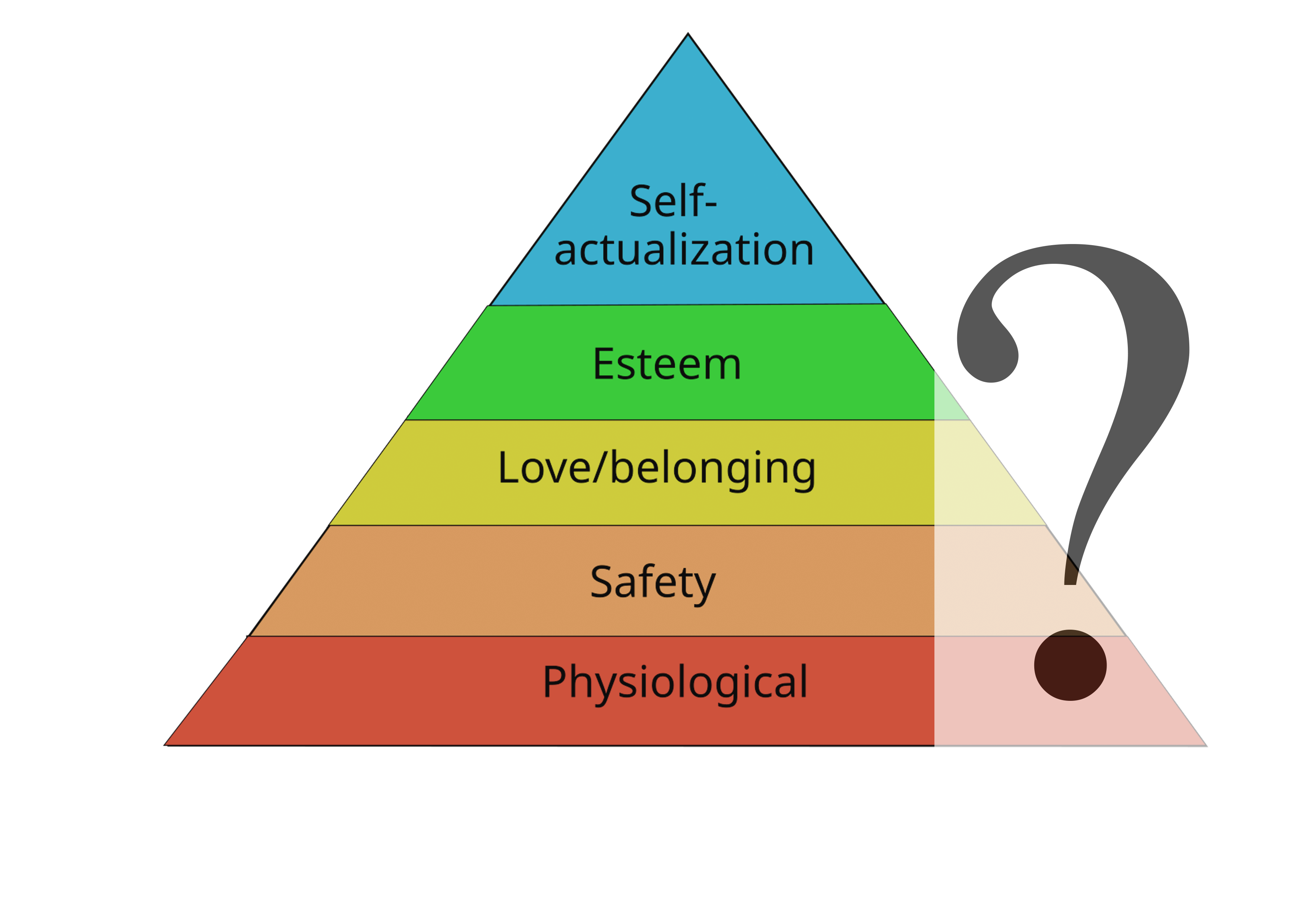
In 1943, Abraham Maslow presented his renowned hierarchy of human needs in a paper titled “A Theory of Human Motivation.” Interestingly, he did not include pyramids to illustrate his theory, even though these pyramidal representations are now more popular than his original paper. Illustrating it as a pyramid, however, encapsulates the essence of his theory.
Humans have physiological needs that must be met, such as hunger, thirst, and warmth. Without them, we die. Once these needs are satisfied, we seek protection and safety from dangers and threats. These two levels form the foundation upon which all depictions of Maslow’s pyramid are built.
After fulfilling their physiological needs, humans must address psychological needs related to the brain and ego. They need to engage in relationships that make them feel like they belong; otherwise, they will be compelled to seek belonging—whether through healthy or pathological means. Then they need to tend to their egos, which require them to feel appreciated for who they are and what they do. Their social position and self-image must align with their expectations.
Check, check, check, and check. Then the human is ready to accomplish all the amazing feats that make humans remarkable: creativity, purpose-seeking, philosophy, etc. Even if it entails undergoing crises and doubting everything they know, they often reach a stage where everything aligns, and they feel like they are becoming the person they truly yearn to be. Whether that happens or not—the destination vs. the journey debate—is not the purpose of this quickly scribed and lightly caffeinated article.
I was thinking about Maslow’s pyramid while making breakfast. I placed a triangular piece of cheese on my bread and thought, “Huh, that’s interesting; it looks like Maslow’s pyramid.” You might ask, where would such a connection come from? It wasn’t Maslow or his theory that occupied my mind the most; it was my academic studies. I mean, I’ve been dreaming about my Western blots for a while now…
I noticed that the state of my Ph.D. often spills over into other domains of my life. If the experiments are going in the right direction—technically sound and yielding data in line with my hypotheses—then the days ahead seem brighter. If the cells are misbehaving, the proteins refuse to show up on the Western blot, or if I used the wrong buffer in the last step of a two-day experiment, then the week is probably not going to be the most enjoyable.
I started thinking: why does this take such a toll?
Well, for starters, pursuing a doctoral degree is a heavy investment. Students dedicate anywhere from three to six years of their lives (and sometimes even more). That’s often the fourth cycle of formal education. While their peers are embarking on career paths or starting exciting projects that do not involve protein detection, graduate students spend their time actively reading and analyzing literature, devising ways to enrich it, and, most importantly, ensuring that their methods are ethically and scientifically sound. Observing exciting data does not necessarily mean it is truly what you think it is. In biology, for example, we need to validate any result in at least three different “populations” of cells. Enter biological variability—the nightmare of bio-scientists.
Apart from the rigorous—and very much needed—process of doctoral studies, there is a trend of pushing for only positive results. Students face intense pressure to report only positive findings (in line with their hypothesis, or sometimes in line with another hypothesis that was previously set aside). This doesn’t mean that negative results are insufficient to earn a Ph.D.; it just means that you’ll have to look for those few institutes that still welcome genuine scientific effort—the way science was meant to be. This is especially true if continuing on the academic path is your intention.
Upon closer examination, graduate studies consume a significant portion of students’ days. Most of the day is spent studying and experimenting, and even when you accomplish your goals for that specific day, you still find yourself thinking about your project: possible explanations for the results, tools and methods to test your hypothesis, and what you are going to do next. It is not easy to detach, even on weekends or vacations. Whether we like it or not, a large portion of our lives during the duration of the degree becomes as focused as the Ph.D. itself. This process can become daunting for many reasons, such as the pressure for positive results, unrealistic expectations, or detachment from the purpose of the studies.
It’s no surprise that when this happens, a significant portion of our lives becomes overwhelming.
Maybe Maslow’s pyramid could use an update to fit the needs of Ph.D. students in the 21st century.

Leave a Reply