
(And Why Mice Everywhere Are Sighing in Relief)
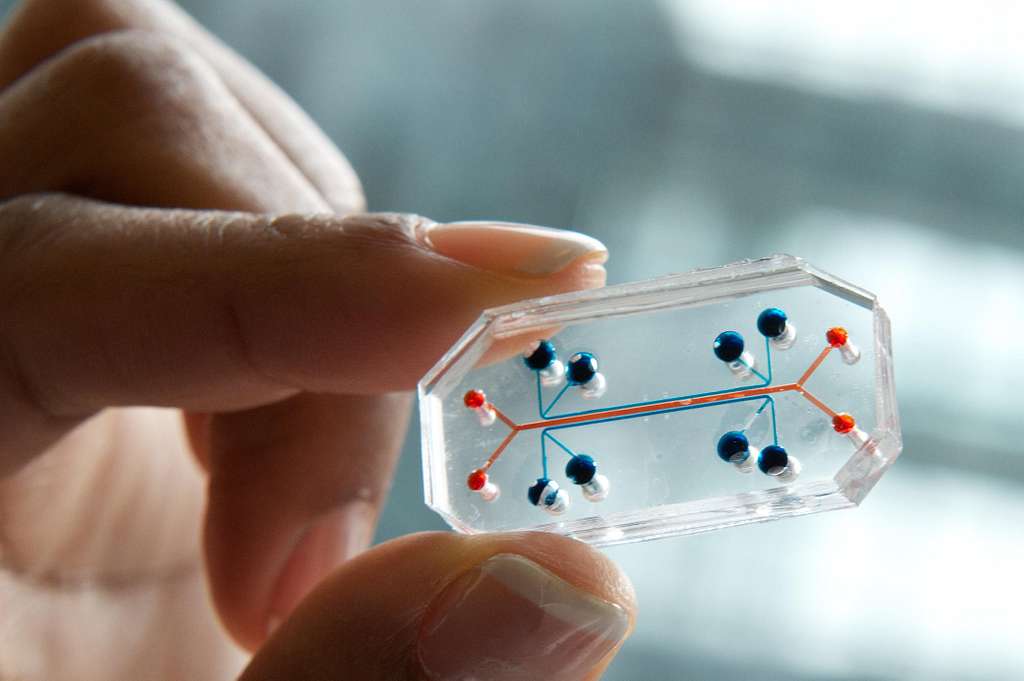
(cover: lung on a chip, Hansjörg Wyss Institute for Biologically Inspired Engineering at Harvard University)
Imagine a world where we could study the inner workings of our organs without, well, needing the whole organ. Once a Sci-Fi idea and now a reality, organoids, that we talked about recently, is not the only way to recapitulate organs in the lab. Enter Organs-on-Chips, a groundbreaking technology that brings the complexity of human biology into a tiny, lab-friendly device. These microfluidic chips are like miniature, living replicas of human organs, and they’re changing the way we approach drug development and disease research. Let’s take a closer look at how these chips evolved and why they’re making waves in the world of biomedical science.
From Concept to Cutting-Edge: The Evolution of Organs-on-Chips
Early Concepts (2000s): The idea of organs-on-chips first popped up in the early 2000s, thanks to the brilliant minds tinkering in the fields of microfluidics and tissue engineering. Picture a bunch of scientists, led by Donald Ingber and his team at Harvard, asking, “What if we could mimic the mechanics and biochemistry of human organs… on a chip?” And just like that, the lung-on-a-chip was born. A small device that could replicate the essential functions of a human lung. The early versions were primitive, but they set the stage for something revolutionary.
Development and Expansion (2010s): Fast forward a decade, and these chips were no longer just an intriguing idea. They were rapidly becoming a tool of choice in labs worldwide. Researchers upped the game, creating more sophisticated chips that could simulate the heart, liver, kidneys, and even the gut. It was like turning a simple steam-engine vehicle into a racing car, complete with real-time sensors and data analysis tools. Suddenly, these chips weren’t just replicating organ function; they were providing a window into the human body that was more detailed than ever before.

Current State (2020s-Present): Today, organs-on-chips are taking the research world by storm. They’ve become the go-to for drug development, disease modeling, and studying human biology in a way that’s never been done before. Researchers are now integrating them with other technologies like organoids, and advanced imaging techniques. The goal? To create a “body-on-a-chip” that could transform everything from personalized medicine to the way we test new therapies. It’s like building a mini-you, but on a chip and without all the messy ethical problems.
Why Are These Organs-on-chips so Special You Ask?
Let’s break it down:
- Drug Screening: Think of these chips as tiny testing grounds where new drugs have to prove their worth. They provide a high-throughput platform to see how new medications interact with different types of human tissues. That’s way more relevant than relying on animal models that sometimes, quite frankly, don’t cut it. It’s like upgrading from a black-and-white TV to HD when it comes to watching drug effects.
- Toxicity Testing: Nobody likes side effects, especially the nasty ones that show up when it’s too late. Organs-on-chips like the liver-on-a-chip can predict potential toxicity early in the drug development process, making it possible to tweak or ditch a drug candidate before it causes harm.
- Disease Modeling: These chips can also mimic diseased tissues, which means scientists can study the progression of conditions like asthma, fibrosis, or even cancer, right on the chip. This opens up endless possibilities not only for testing new treatments but more importantly for understanding how a disease operates on a cellular level (key to understanding diseases that we cannot access like Parkinson’s for example).
Why Organs-on-Chips Are Winning Over Traditional Methods
- Physiological Relevance: Traditional 2D cell cultures lack the complexity of living systems. Organs-on-chips, however, offer a 3D environment that better mimics the real deal. This leads to more reliable predictions of how a drug will behave in humans, which is kind of the whole point, right?
- Ethical and Accurate: The more we can cut down on animal testing, the better (for science and for our furry friends). Organs-on-chips offer a more ethical and potentially more accurate alternative, reducing the need for animal subjects that often don’t reflect human biology a 100%.
- Customization is Key: These chips can be tailored to replicate specific patient conditions, meaning drug testing and development can be far more personalized.

But Wait, There’s a Catch…
As exciting as it all sounds, it’s not without its hurdles:
- Complexity: Developing these chips is like trying to bake a cake while juggling. You need precise control over fluid dynamics, cellular environments, and sensor integration. One wrong move, and the whole thing could flop.
- Standardization Woes: With so many different designs and approaches, getting everyone on the same page is tough. Lack of standardization makes it hard to compare results across studies, which can be a major speed bump on the road to regulatory approval.
- Scaling Up: Making a handful of chips for a lab study? Easy. Producing them on a large scale for widespread use? Not so much. We’re talking about moving from a hand-craft operation to mass production, and that is a challenge requiring more than just technical expertise.
The Future of Organs-on-Chips: A Glimpse Ahead
Despite the hurdles, the potential of organs-on-chips is too big to ignore. They could soon be a staple in labs worldwide, not just for drug development but for personalized medicine, disease modeling, and beyond. The dream is a “human-on-a-chip”—a comprehensive model that could revolutionize how we approach medicine, making treatments safer, faster, and more effective (but is going to look a bit weird, aesthetically speaking).
So, the next time you hear someone mention organs-on-chips, know that they’re not talking about some weird new snack. They’re talking about a game-changing technology that could redefine medicine as we know it. And honestly, that’s pretty cool.
(Read more in this interesting article)
Leave a Reply